

digiLab AI sailing model cuts prediction error by 85%
Tue, 16th Jun 2026
digiLab has released results from its work with British sailor Joss Creswell on an AI-based sailing performance model. The Exeter company said the model cut prediction error over a season of racing and retraining.
The project used Creswell's campaign in La Solitaire du Figaro Paprec, a solo offshore race widely regarded as one of sailing's toughest tests, as a real-world trial for software designed to assess likely outcomes and the uncertainty around them.
Over the past year, digiLab's research team developed a personalised model based on Creswell's own sailing data rather than the standard factory polar, which is used as a generic benchmark for boat performance. In one-design Figaro racing, where sailors use identical boats and equipment, gains often depend on how well competitors understand their own handling and decision-making in changing conditions.
According to digiLab, the model reduced average speed prediction error by 33% compared with the factory polar when using data from the previous racing season. After retraining with data collected during the Solo Guy Cotten race, average prediction error fell from 2.91 knots to 0.43 knots, an improvement of more than 85%.
The model now explains more than 93% of observed variation in boat speed, digiLab said. Alongside each forecast, the system produces uncertainty ranges that captured real-world outcomes about 95% of the time, according to the company.
Race conditions
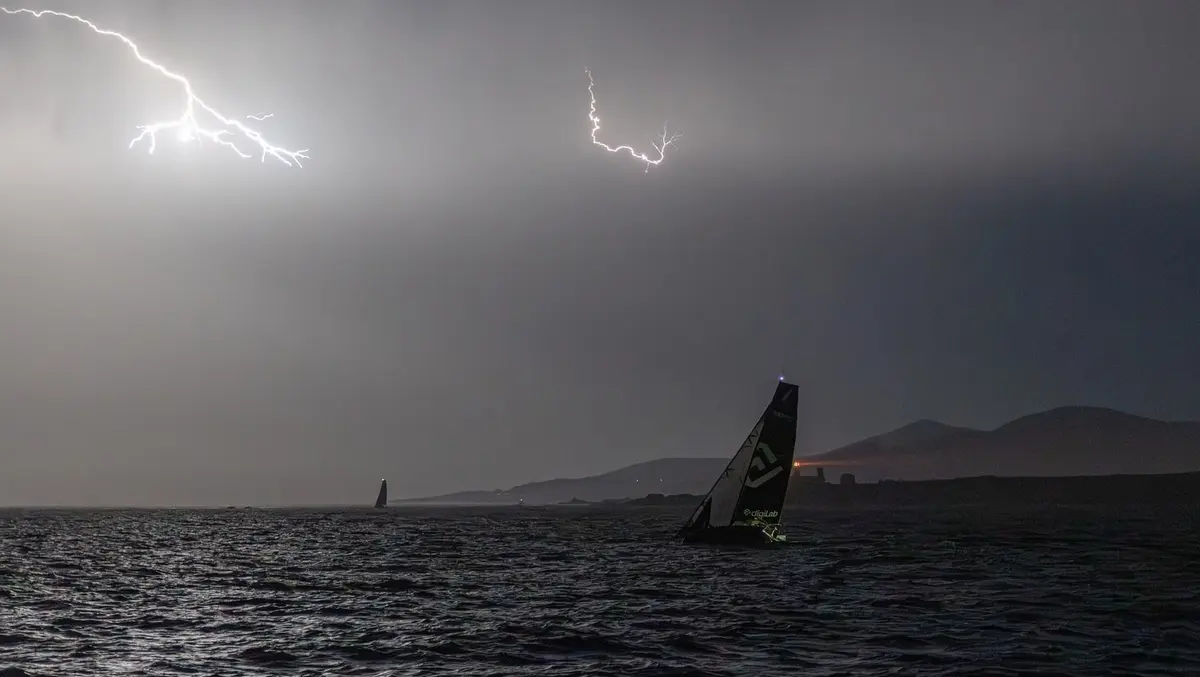
The figures emerged after a difficult edition of La Solitaire, a three-stage race of about 1,500 nautical miles that attracts many of the sport's leading offshore sailors. This year's race included a 45-knot gale, three-metre waves, multiple retirements, two dismastings and a helicopter rescue.
Those conditions made the sailing programme a useful test for a system designed to work when information is incomplete and circumstances change quickly. Rather than limiting the model to a simple speed estimate, digiLab aimed to show when the software was highly confident in a forecast and when wider uncertainty should shape decision-making.
Professor Tim Dodwell, Chief Executive Officer and Founder of digiLab, linked the sailing work to broader industrial use cases.
"Offshore racing is one of the most demanding environments imaginable for decision-making. Conditions change constantly, information is incomplete, and the consequences of getting it wrong are immediate. That's exactly why it's such a powerful testbed for our technology. The same challenge exists across energy, infrastructure, defence and maritime operations, where organisations need to make critical decisions despite uncertainty. Our goal is to help people move beyond guesswork and make better decisions with greater confidence, even when the stakes are at their highest," said Dodwell.
Wider uses
digiLab is positioning the sailing work as evidence for applications beyond sport. Areas such as energy systems, infrastructure management and maritime operations often require decisions to be made with partial or fast-changing data, particularly when weather, equipment condition or operating constraints can shift rapidly.
In those settings, software that provides not only a forecast but also the likely margin of error could influence how operators assess risk. That approach has become more prominent as companies and public bodies seek to use machine learning in environments where a wrong decision may carry operational, financial or safety consequences.
Creswell's programme also gave digiLab a continuous stream of field data rather than a controlled laboratory environment. Each mile sailed added information on how a specific skipper handled a specific boat across a range of race and weather conditions, allowing the model to be refined as the season progressed.
Creswell said the project's value lay in how the model learned from racing conditions and fed that back into future preparation.
"La Solitaire lived up to its reputation as one of the toughest challenges in sailing. We faced everything from a 45-knot gale and three-metre seas to equipment failures and retirements across the fleet, so simply getting to the finish required constant focus and resilience. What makes working with digiLab so exciting is that every mile sailed and every challenge faced becomes part of a growing body of knowledge. The model keeps learning from my racing, helping me better understand my performance and explore different scenarios before I get back on the water. This race proved to me that I can compete at this level, but it also showed me how much more there is to learn. That's the exciting part. I crossed the finish line already thinking about the next race and how we can use everything we've learned this season to come back stronger," said Creswell.
For digiLab, the sailing project provides a practical example of how uncertainty-aware AI can be trained in one of the most variable operating environments and then adapted for use in sectors where decisions cannot wait for perfect information.