

Explainer: How loop engineering is changing coding
Wed, 24th Jun 2026
Loop engineering has become a new term in AI coding. It describes a shift from one-shot prompts to repeatable cycles of planning, changing, testing and revising. For software teams, the idea matters because AI agents can now edit repositories, run checks and prepare pull requests. They still need structure to avoid expensive mistakes.
For several years, most AI coding tools were sold as faster autocomplete. A developer wrote a prompt or comment, accepted a suggestion, then carried on with testing, debugging and review. That model still exists, but the centre of gravity has moved. Newer tools can inspect a repository, edit several files, run a test suite, read an error message and try again.
That is where loop engineering begins. The goal is not to get a strong first answer from a model. It is to build a workflow in which a weak first answer can be corrected before it reaches production. In practice, that means deciding what the agent can see, what it can change, which checks it should trust and when a human needs to step in.
Old loops
The structure will sound familiar to any experienced engineer. Write code. Compile it. Run tests. Read the failure. Adjust the code. Ask for a review. Continuous integration turned that habit into an automated pipeline. Test-driven development did the same at the level of features and bugs. The red-green-refactor cycle was a loop long before anyone attached an AI model to it.
The change came with large language models that could take part in the cycle themselves. GitHub Copilot arrived in 2021 as an "AI pair programmer". It was useful, but mostly at the point of generation. In 2022, researchers behind ReAct argued that language models work better when reasoning and acting are interleaved. In 2023, SWE-bench gave the industry a harsher test: real GitHub issues in real repositories, where success depended on understanding context, editing code and passing checks.
By 2024, systems such as SWE-agent showed that interface design mattered almost as much as model quality. Give an agent better ways to navigate files, edit code and execute programs, and performance improves. Commercial tools then pushed the idea into mainstream development. By 2025 and 2026, products from Anthropic, OpenAI and others were offering coding agents that could work in sandboxes, run linters and tests, produce diffs and prepare pull requests.
Core loop
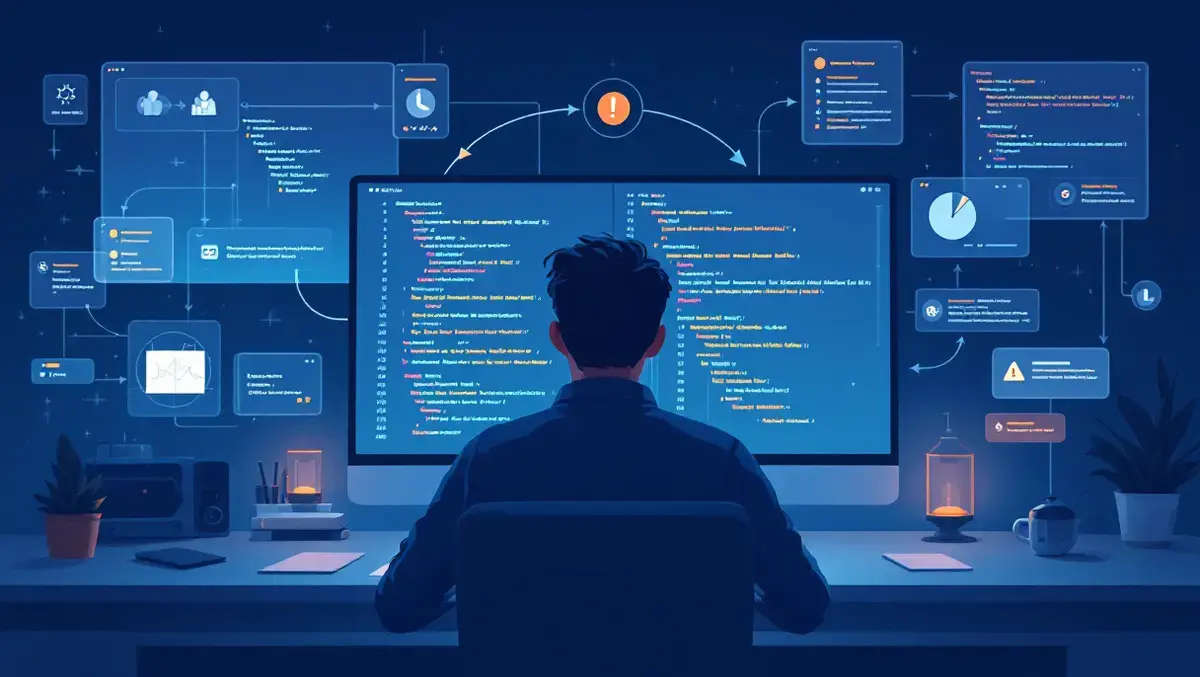
Strip away the branding and most of these systems follow the same pattern. First comes intent. The developer states the outcome. Next comes context. The agent gathers the relevant files, logs, tests and conventions. Then comes action, usually a small code change. After that comes observation: a compiler error, a test output, a screenshot or a code review comment. The final stage is adjustment. The agent updates its plan and takes another pass.
This matters because software tasks are full of hidden constraints. Often, the real signal arrives after the first edit. A type checker exposes a missing import. A failing regression test shows the wrong fix. A browser screenshot reveals that the layout still breaks on mobile. Without a loop, those signals arrive too late and land on a human reviewer. With a loop, they become part of the system.
Strong loops are narrow. They ask the agent to make the smallest coherent change, then prove it worked. A billing bug becomes a failing regression test, a patch to the escaping or validation logic, and a rerun of that test. A dependency upgrade becomes a sequence of compile failures, targeted edits and another pass through the build. The loop closes when the evidence is good enough, rather than when the draft looks plausible.
Prompt engineering still matters. Clear instructions help an agent start in the right place. Loop engineering shifts the emphasis. A prompt is the opening move. The loop handles the rest.
Team rules
This is where the idea moves from clever demo to engineering practice. Teams that want useful loops usually need four things.
First comes a clear definition of done. "Improve the dashboard" is too loose. "Defer non-critical charts so first load is quicker while keeping filters unchanged" gives the agent a measurable target. Repository context comes next. Agents work better when they can see coding standards, test commands and examples of existing patterns. That context may sit in documentation, instruction files or a well-kept README.
Observability follows. If an agent cannot run the right tests or inspect the right logs, it is guessing. Modern coding tools increasingly reflect this. Some ask users to specify checks up front. Others encourage plans first and code second, so the agent explores before it edits. Cloud tools now return terminal logs, test results and diff views because the core question for a developer is, "What evidence does it have?"
Governance is the final requirement. Autonomy saves time until it touches the wrong file, pushes to the wrong branch or sends secrets to the wrong service. That is why modern coding agents put so much work into permission modes, protected paths and review steps. The newer sales pitch is bounded autonomy.
In practical terms, that usually means small, reversible actions. Ask the agent to fix one failing test rather than rewrite a subsystem. Ask it to open a draft pull request rather than merge. Ask it to stop when a credential is missing or when product intent becomes ambiguous. A good loop should know when to halt as well as when to continue.
Human role
Loops change the human engineer's role. Humans set scope, define trade-offs, judge product intent and review risk. Agents are increasingly useful at the mechanics in between: tracing a stack, updating fixtures, repairing lint failures, mapping files that need to change and carrying a patch through to a passing build.
That distinction matters because software quality is rarely a single-variable problem. A patch can satisfy the tests and still create a worse user journey. A refactor can look neat and still undermine observability. A code review comment can reveal a requirement that never appeared in the original ticket. In each case, the human part is judgement. The machine part is iteration.
This is also why one common loop design uses one agent to produce code and another to review or verify it. The logic is straightforward. An agent that wrote the patch is poorly placed to grade its own work. A second pass, whether from another model or a human reviewer, adds friction in the right place.
Hard edges
"Loop engineering" can make the process sound tidier than it is. Real repositories are messy. Tests are incomplete. Even the easiest signal is not always the most reliable one.
That weakness shows up in benchmarks. Passing tests can still disguise a bad patch if the tests are too narrow. Security remains another weak point. Early studies of AI-generated code found vulnerable patterns in suggested programs, and those concerns have carried into the agent era. The shape of the risk has changed. It now includes the agent's actions as well as its output: the command it runs, the dependency it installs, the data it reads and the service it calls.
There is also a productivity trap. AI coding tools can look fast because they produce visible output quickly. Hidden costs emerge later, when a developer has to inspect, correct and maintain that output. Recent research with experienced open-source developers found that early-2025 AI tools slowed them down on tasks in codebases they already knew well. That leaves the wider productivity argument open, but makes one point clear. Loops reduce verification work only when the checks are trustworthy and the task suits the tool.
Adoption data still explain why the industry keeps pushing. Large studies of GitHub activity now track vast numbers of agent-authored pull requests across several tools. That volume suggests this is already part of mainstream software work. It also shows a trust gap. Agent-created pull requests arrive quickly, but acceptance varies across task types. They still need human judgement on architecture, product intent and risk.
What lasts
Loop engineering is likely to remain useful even if the phrase fades. It names a shift from text generation to process design. The harder question in AI coding is no longer, "What prompt should I write?" It is, "What evidence should count as progress, and what happens next when the evidence says the model is wrong?"
For software teams, the answer will rarely be one grand workflow. It will be a set of smaller loops: a bug-fix loop, a review loop, a migration loop and a UI verification loop. Each one pairs a task with the feedback that matters most. That is less theatrical than the idea of an autonomous software engineer. It is closer to how reliable software is actually shipped.