

Enlightra uses Yokogawa analysers for AI data-centre links
Wed, 12th Aug 2026 (Today)
Enlightra is using Yokogawa optical spectrum analysers to develop optical interconnect technology for AI data centres, with a focus on frequency-comb laser systems for multi-channel optical links.
The Swiss photonics company is developing compact laser sources based on optical frequency combs, which generate multiple optical wavelengths from a single laser. The approach is intended to reduce the need for a separate laser for each communication channel in high-speed optical links.
Rising AI workloads have increased pressure on data-centre operators to move more data between processors, memory and networking equipment. That has driven greater interest in optical interconnects as conventional electrical connections approach bandwidth and efficiency limits.
Its systems are designed to generate between 8 and 32 comb lines, with channel spacing from 100 to 800 GHz. Power per line exceeds 7 dBm across O-band datacom and C-band telecom wavelengths.
That design places heavy emphasis on measurement. Engineers must verify the number of channels, their spacing, power per line, channel-to-channel variation and the optical noise floor, while maintaining a high optical signal-to-noise ratio for reliable transmission.
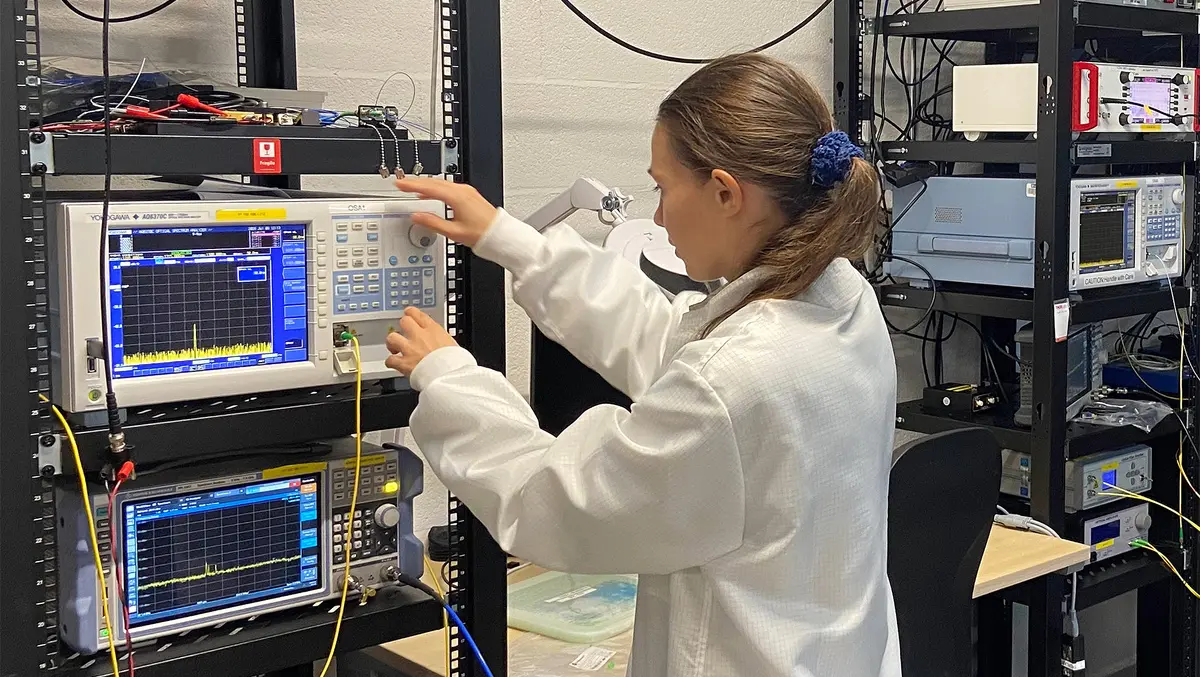
Because Enlightra characterises thousands of photonic chips during development, speed and repeatability in testing are central to the process. Yokogawa's optical spectrum analysers are being used to capture high-resolution measurements across a broad wavelength range as the company assesses chip performance.
One instrument in use is the AQ6370E optical spectrum analyser, which offers 0.02 nm resolution. It also provides a close-in dynamic range of more than 70 dB, allowing engineers to distinguish individual comb lines and assess the noise floor between channels.
Why it matters
Frequency-comb lasers have attracted attention because they could simplify optical architectures inside AI infrastructure. Instead of relying on an array of separate lasers, designers can use one source to produce multiple tightly controlled wavelengths for several communication channels.
That simplification works only if each comb line is stable, evenly spaced and strong enough for transmission. Small measurement errors can affect how engineers assess line spacing, spectral flatness and signal quality, particularly when channels are closely packed.
Enlightra said portable field instruments previously used for demonstrations did not always reproduce the resolution and low-noise performance available in the laboratory. According to the company, that could distort the appearance of individual comb lines, reduce displayed peak power values and obscure the true noise floor.
Using the same class of optical spectrum analyser in both development and customer-facing demonstrations is intended to reduce that gap. For a company seeking to validate a new photonics platform, consistency between lab testing and external demonstrations can influence how potential customers judge the credibility of performance claims.
Design demands
Optical interconnects for AI data centres face technical demands beyond raw speed. Systems must also manage thermal constraints, power consumption and physical density, particularly as operators seek to connect larger clusters of accelerators and storage more efficiently.
In that context, multi-wavelength laser sources are being studied as a way to increase link density without scaling component counts linearly. A comb-based design can, in principle, support multiple wavelengths from one source, but only if the optical spectrum can be measured and controlled precisely through development and production.
That has made test equipment a more visible part of the photonics supply chain. For developers such as Enlightra, the challenge is not only to produce suitable laser output, but also to demonstrate repeatable data across a large volume of chip samples.
Hanae Zegmout, Lead Photonic Designer at Enlightra, commented on the company's choice of measurement tools.
"In the frequency comb space, Yokogawa is the gold standard. Choosing its spectrum analyzers ensures that our data is immediately trusted and recognized," said Zegmout.
She also gave a separate assessment of the equipment used in Enlightra's lab.
"Our experience with the two Yokogawa systems in our lab shows that these analyzers are robust, hold their calibration well, and offer a seamless user experience," said Zegmout.