

David Jones CEO puts supply chain at heart of strategy
Wed, 8th Jul 2026
David Jones Chief Executive Officer Erica Berchtold has outlined plans to make supply chain central to the retailer's strategy in her first public comments since taking the top job.
She linked the department store's turnaround to fulfilment, inventory control and distribution, arguing these functions should sit at the centre of decision-making rather than behind the scenes.
Berchtold succeeded Scott Fyfe after serving as Chief Commercial Officer, with the leadership change coming as David Jones secured a financing facility from British lender Hilco Capital. She takes over as the retailer sharpens its focus on fashion and online luxury sales while updating the department store model for changing shopping habits.
She described the movement of stock through warehouses and distribution centres as integral to the customer offer.
"There's as much beauty in the movement of inventory in and out of a distribution centre, and onto the customer, as there is in the product itself," said Erica Berchtold, Chief Executive Officer, David Jones.
"If you can get that humming and efficient, that is as beautiful as the dress you're selling. It's a mantra I live by now."
Her comments highlight the operational pressure facing department stores as consumer demand remains uneven and costs rise across labour, logistics and property. For retailers with thin margins, delays in moving stock or errors in forecasting can quickly erode profits.
That leaves little room for mistakes.
"The retail landscape is littered with supply chain horror stories," Berchtold said.
"Margins are getting tighter, cost of doing business is increasing, and customers have cost-of-living pressures. This needs to be a seamless and efficient part of your business."
Operational focus
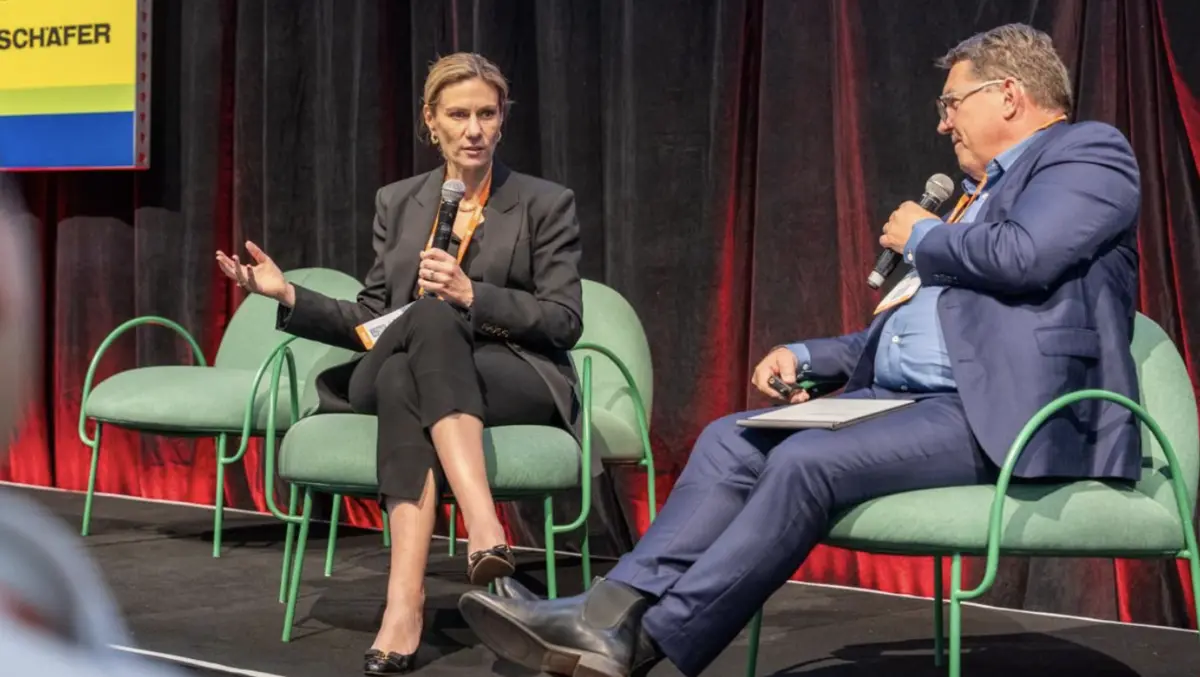
Peter Jones, Managing Director at Prological, who appeared alongside Berchtold, said the discussion showed how closely retail strategy and logistics are now linked. He added that warehouse investment can require very large sums of capital and demands careful preparation.
"Supply chain, highly automated warehouses can run into hundreds of millions in capital, so you need an appetite to prepare and problem solve. Supply chain is critical to retail strategy, not as a back-of-house function, but as a driver of the bottom line," said Peter Jones, Managing Director, Prological.
Jones also commented on Berchtold's management style.
"We're grateful for the authenticity that Erica brings to every conversation. When Erica says to think outside the box, she is chasing solutions, not just definitions of the problems," he said.
Berchtold told the audience she wanted teams to identify risks and bring solutions with them, reflecting a practical approach at the start of her tenure.
"I want to know the challenges, the problems, the risks, but turn that full stop after this into a comma and tell me what you are going to do, resolution attached," she said.
Data and stock
Another theme of her remarks was the role of data, artificial intelligence and forecasting in managing inventory more precisely. That is particularly important in fashion retail, where over-ordering can lead to discounting and under-ordering can leave customers unable to find sought-after items.
"You've got to be very Goldilocks when it comes to inventory, particularly in fashion retail," she said.
"Not too much, not too little, just right. Being able to forecast better and make better decisions for future orders is really important."
She drew on her earlier experience at The Iconic, where rapid online growth during the pandemic exposed the limits of warehouse space and pushed supply chain issues to the forefront of executive discussions. That experience, she said, changed how the business prioritised logistics internally.
"We hit a point where we couldn't get another unit into our warehouse, and because of that, we couldn't get another unit out," she said.
"In our weekly trade meetings, supply chain would get the last minute of the conversation. We realised that needed to flip. If you can't get product in and out of your distribution centre, it doesn't matter what marketing you do or what customers want, you can't deliver it. So, we put supply chain at the start of the meeting instead of the end."
She also warned retailers against assuming automation alone will solve bottlenecks, saying process design can be the bigger issue.
"What we found was the automation wasn't the problem, our processes were," she said.
"We were using a system designed for fast-moving product as a storage facility. Have a look at your processes before you look at the system or the equipment."