

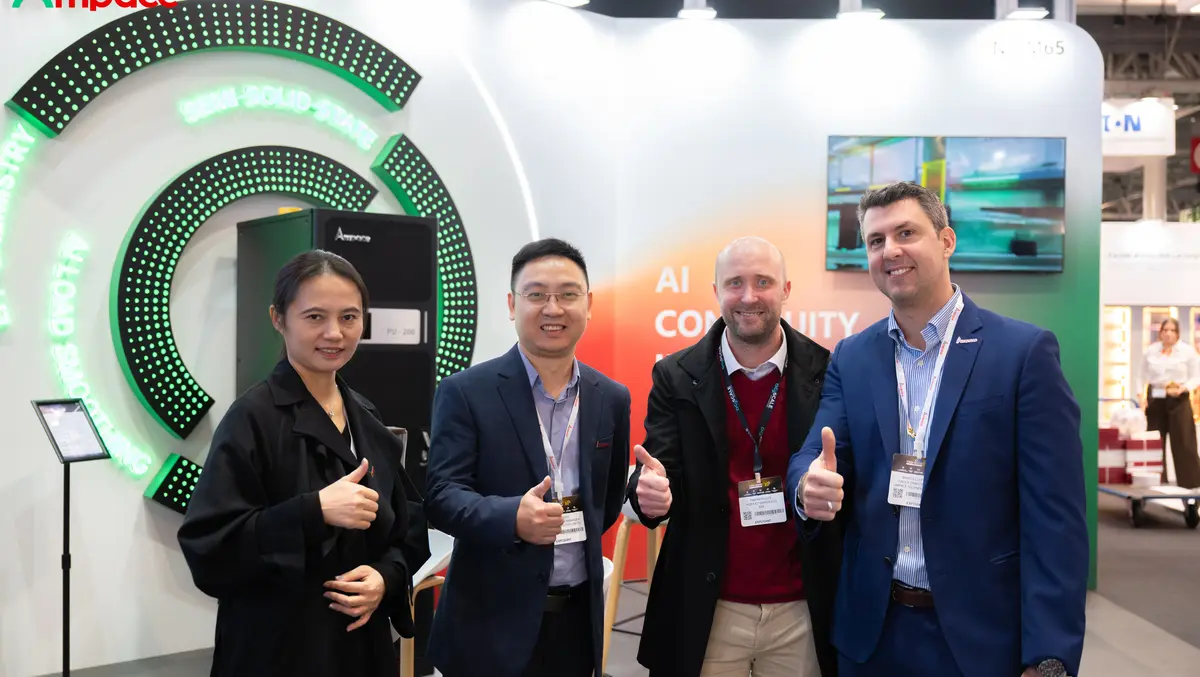
Ampace unveils compact UPS battery for AI data centres
Thu, 26th Nov 2026 (Today)
Ampace has presented its PU200 UPS battery system for AI data centres in Paris and disclosed fire test results for its PU100 backup battery system.
The announcements focus on two issues facing data centre operators as AI workloads increase power density across facilities: fitting backup power into limited space and assessing battery safety in critical infrastructure.
The PU200 uses semi-solid-state lithium iron phosphate cells and is designed for uninterruptible power supply use when mains power fails. The system combines high-rate discharge with a compact cabinet format for sites where battery room space is constrained.
According to Ampace, the PU200 delivers 462 kW per cabinet. It also has a detachable battery management system to ease servicing and can be installed in both traditional and modular data centre layouts.
Safety focus
Battery safety has become a bigger part of procurement decisions as operators consider lithium-ion systems for standby power in facilities that support round-the-clock computing loads. Ampace said its design approach links cell chemistry, thermal management and protection at module and cabinet level.
A UPS battery may remain idle for long periods before it is required to deliver high output within seconds. Against that backdrop, Ampace said it designs cells with low internal resistance to reduce heat generation during high-rate discharge and support stable delivery until another power source takes over.
Ampace also pointed to recent large-scale fire testing of its PU100 UPS battery system under the sixth edition of UL 9540A, saying the PU100 met the applicable test criteria.
That result gives operators another reference point as they weigh the fire risk of battery systems used in backup applications. The test concerns the behaviour of a full system under defined fire conditions rather than cell performance alone.
AI demand
The backdrop to the launch is the rapid expansion of AI infrastructure in Europe, where operators are under pressure to support denser computing environments and larger power loads. That trend has brought greater scrutiny to the physical footprint of electrical equipment and the resilience of power systems.
In practice, backup power planning involves trade-offs between discharge performance, available floor space, maintenance access and safety measures. Suppliers are increasingly trying to address those requirements at cabinet level rather than treating them as separate engineering questions.
Ampace said it develops the cells, modules and complete battery systems used in its data centre range. Its engineers work back from installation requirements to the cell, with UPS power demands, expected heat during discharge and facility space shaping the design of the final cabinet.
System design
The use of lithium iron phosphate chemistry reflects a wider shift in stationary battery applications, where operators have favoured chemistries seen as more stable than alternatives used previously in some energy storage and backup systems. Semi-solid-state designs are also drawing attention as manufacturers look to improve safety characteristics while maintaining the output required for short-duration, high-power discharge.
For data centres, that matters because the role of the UPS battery is narrow but critical. It does not need to sustain the full load for long periods, but it must respond instantly and predictably during the gap between a grid outage and the start of an alternative supply.
The compact format of the PU200 may be relevant for operators retrofitting existing sites as well as those planning modular facilities, where floor space can be tightly constrained by the economics of high-density computing. Easier service access through a detachable battery management system may also appeal to operators seeking to reduce intervention time in live environments.
Ampace has framed the PU200 and PU100 as part of a broader battery offering for AI data centre applications, spanning cells to integrated backup systems. It said its work on safety and compact design reflects the practical demands of operators balancing resilience, layout and maintenance in facilities where power interruptions cannot be tolerated.