

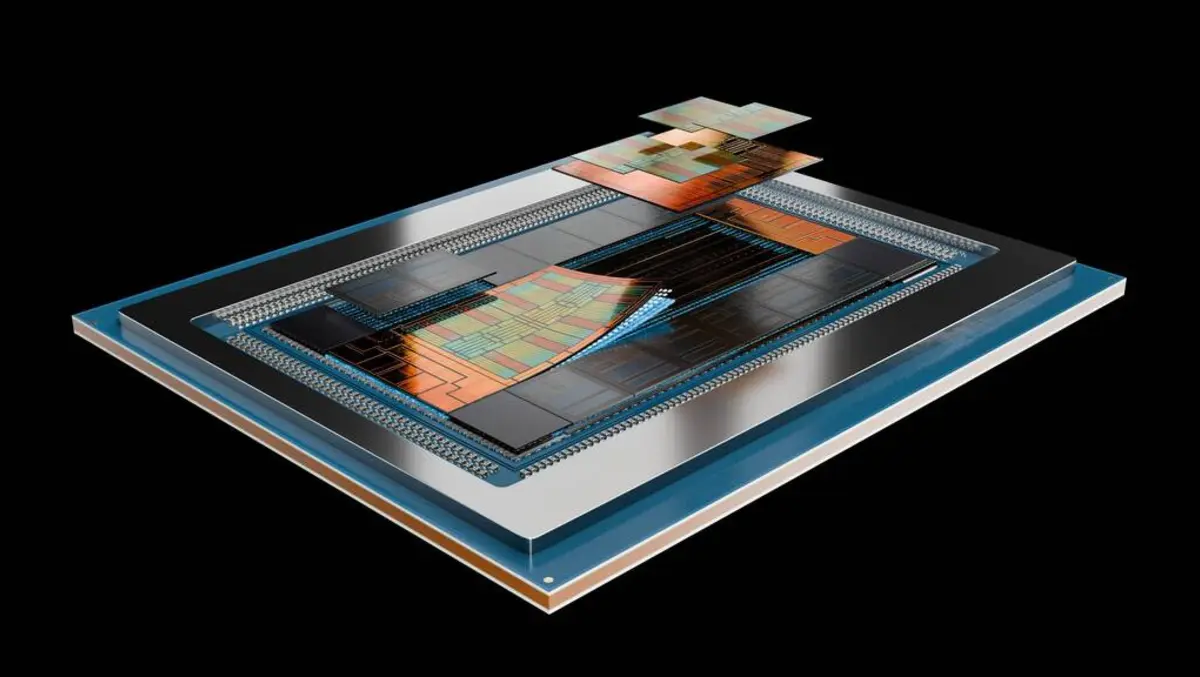

AMD has expanded its Instinct MI400 Series GPU line-up with updates for scientific computing and artificial intelligence. The changes include new details on the MI430X, fresh inference results for the MI455X and the launch of the MI450X.
The additions target customers using the Helios rackscale system for AI and high-performance computing workloads, including scientific simulation and interactive inference.
The MI430X is aimed at research workloads that combine traditional simulation with AI models. It includes native FP64 support for scientific calculations, along with 432GB of HBM4 memory and memory bandwidth of up to 23.3 terabytes per second.
Those specifications matter for users running large simulations and handling bigger scientific datasets, where double-precision arithmetic remains necessary in parts of the workflow. AMD said its research reviewed 47 workload configurations across 11 applications and benchmarks to assess when FP64 emulation may be sufficient and when native double precision is still required.
AMD argued the findings support continued demand for hardware that can handle both AI tasks and conventional high-performance computing jobs in the same environment.
Inference results
Alongside the scientific computing update, AMD published new measured inference figures for the MI455X running on Helios. The company said the system delivered 21,333 tokens per second per GPU on DeepSeek-R1 in an MLPerf Inference Offline configuration.
AMD said that result represented throughput up to 30% higher than Nvidia Vera Rubin's latest published MLPerf Offline result. It also said Helios offers up to 20% higher HBM bandwidth than Nvidia Vera Rubin, along with higher scale-up bandwidth, which it linked to the reported inference performance.
The comparison is based on AMD Performance Labs testing and published MLPerf results for Nvidia's platform. As with most benchmark disclosures, the figures depend on system configuration, software versions and model setup.
New option
AMD also introduced the MI450X as another configuration in the MI400 Series. The new GPU is intended to give Helios customers a lower-memory option than the MI455X while keeping the same core compute, memory bandwidth and connectivity profile.
The MI450X comes with 288GB of HBM4 memory per GPU. AMD said the part is designed for workloads that fit within that memory footprint, giving customers another way to balance throughput, response times and operating costs.
Both the MI450X and MI455X are supported by the same Helios rack-scale architecture and AMD's ROCm software stack. AMD said the MI455X remains the option for users that need more memory headroom for larger models, longer context windows or higher concurrency.
The broader message from the update is that AMD is trying to offer a more segmented product range within a single infrastructure platform. That approach reflects a market in which buyers are increasingly matching accelerators to narrower workload profiles rather than relying on a single top-end configuration for every use case.
Competition in AI infrastructure has also shifted beyond raw processor performance to questions of memory capacity, interconnect bandwidth and how systems are assembled at rack level. Those factors are becoming more important as model sizes increase and inference workloads move from batch processing to more interactive deployment patterns.
For scientific computing customers, memory and precision remain central design trade-offs. Research institutions and industrial users still run applications that depend on native double precision, even as AI methods are incorporated into simulation pipelines.
For AI buyers, the question is often whether a system can support large models efficiently at the right latency and cost. By introducing a second memory configuration on Helios, AMD appears to be targeting that operational distinction more directly.
"AMD Instinct MI400 Series GPUs bring leadership performance and new capabilities to AI and scientific computing. With advances in high-precision compute, new milestones in AI inference performance and an expanded range of configurations, we're giving customers more options to power their next generation of AI and HPC workloads," said Andrew Dieckmann, Corporate Vice President and General Manager, Data Centre GPU Business, AMD.