


Envision unveiled three integrated energy systems in Europe, focused on power supply for AI data centres, electricity grids and industrial users.
The products were an AI Power System, the Gen 8 4.X MWh Long-Duration Energy Storage System, and a hybrid wind-solar-storage solution using the company's own solar inverter.
The launch also set out a broader strategy built around linking generation, storage, power electronics and software in a single architecture. The systems are intended to address rising electricity demand from AI computing, the need for stability in grids with high renewable penetration, and industrial demand for lower-carbon power.
Kevin Huang, Senior Vice President and President of Energy Storage Product Line at Envision, said pressure on electricity supply is becoming a constraint on expansion in several sectors.
"The bottleneck for AI and industrial growth is increasingly the availability of reliable, affordable and low-carbon power," Huang said. "The next phase of the energy transition will not be defined by cost per watt hour alone, but by the competitiveness of the entire power system. Our goal is to make renewable energy not only clean, but stable, dispatchable and economically competitive at scale."
AI power
A central part of the launch was Envision's AI Power System, aimed at data centres facing steep growth in computing loads. The system manages generation, storage, grid interaction and computing demand across three layers: grid-side wind, solar and storage assets; a medium-voltage grid-forming battery energy storage system; and an 800V direct current architecture using solid-state transformer technology.
According to Envision, its 2.5 MW solid-state transformer container converts 10 or 13.8 kV alternating current input into 800V direct current output, with conversion efficiency of up to 98.5%. The design can also cut copper use by as much as 80%.
It is pairing that setup with two 800V direct current storage options. One is a lithium iron phosphate system for backup power and multi-hour energy shifting, with output of up to 2.5 MW and duration of two hours or more. The other uses sodium-ion chemistry and is designed for fast charging and discharging over minutes to smooth sharp swings in demand from AI workloads.
The AI Power System is already operating at Envision's Chifeng Net-Zero Industrial Park in a project developed with Tencent. The company is also building what it described as the Envision Galaxy Campus in Ulanqab, a gigawatt-scale AI data centre linked directly to renewable energy.
Envision tied that work to Mission Gobi, an initiative aimed at developing 5 GW of green AI data centre capacity in desert and arid regions by 2030.
Long-duration storage
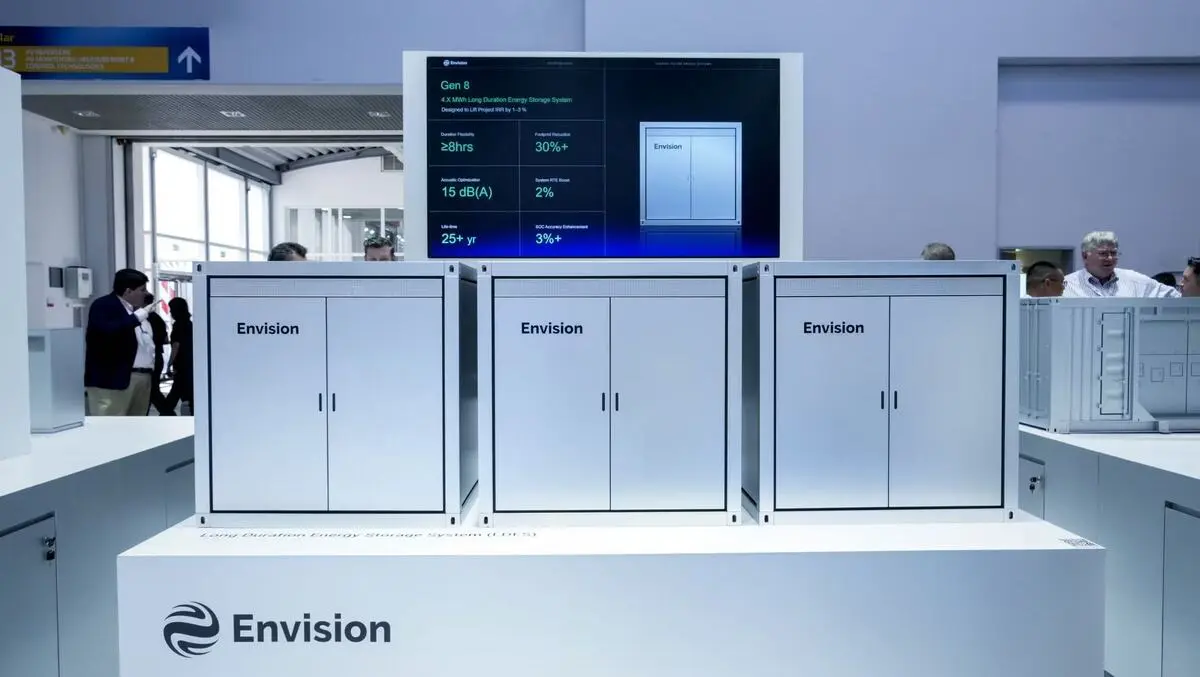
The second product was the Gen 8 4.X MWh Long-Duration Energy Storage System, built for grids with large shares of renewable generation and for firm power supply. The system supports storage duration of between eight and 16 hours.
It is based on Envision's own battery cells and silicon carbide string power conversion technology. The system provides 250% overload capability for grid-forming applications, a specification intended to help maintain voltage-source behaviour during large transients examined in grid impact studies.
Round-trip efficiency is up to 91%, and the design life is 25 years. Envision also said the unit improves state-of-charge accuracy to 2% and runs at noise levels 15 dB(A) below industry norms.
For tougher operating conditions, the system is designed to work in temperatures from -40C to 50C, with an optional corrosion protection grade for harsher environments. Envision said the modular layout reduces footprint by more than 30% compared with typical 5 to 7 MWh systems, while keeping unit weight below 30 tonnes to simplify transport and installation.
Hybrid system
The third element of the launch was a hybrid wind, solar and storage system for industrial and utility customers. The addition of Envision's grid-tied photovoltaic string inverter in Europe means the group can now combine its own power electronics with a real-time coordination platform in one architecture.
The system is intended to manage projects through design, delivery and operation. According to Envision, it coordinates on-site renewable generation, storage, grid links and electricity consumption for industrial users, while also offering services covering forecasting, planning, dispatch and operations.
The announcement comes as technology groups, utilities and industrial operators face rising scrutiny over the cost, availability and carbon intensity of electricity. Demand from AI infrastructure in particular has intensified debate over whether grids and generation projects can keep pace, especially in markets trying to expand renewable supply without sacrificing reliability.
Against that backdrop, Envision's launch highlights the growing commercial focus on integrated systems rather than single pieces of equipment. Its approach spans battery cells, storage systems, power electronics, digital platforms and real-time coordination.
It also underlines how suppliers are positioning storage and hybrid generation not only as tools for balancing renewable output, but as part of the core infrastructure for computing, manufacturing and grid stability. Envision said the three systems were designed around those three use cases: AI infrastructure, renewable-heavy grids and industrial decarbonisation.