

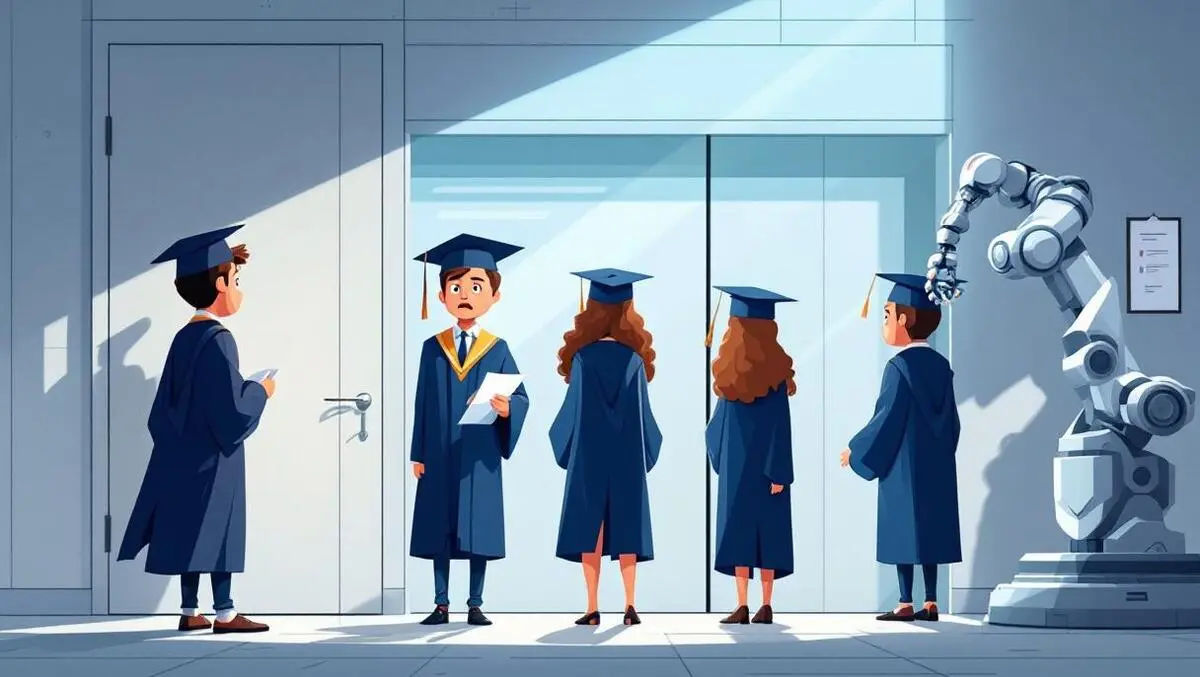

New survey data has highlighted widespread concerns among UK students regarding their future employability, as four out of five respondents expressed fears that artificial intelligence (AI) could make human workers redundant.
The findings, derived from a global survey of 7,274 students across nine countries by student accommodation provider Yugo, come at a time when the UK job market for entry-level roles is experiencing a significant downturn, with openings having decreased by nearly 30% since 2022.
AI anxieties
The research reveals a deep sense of uncertainty among Gen Z students about the traditional value of university degrees as a pathway to secure employment, given the rapid advancement and integration of AI technologies in various sectors.
While 44% of UK students see promise in AI, citing potential boosts to productivity, healthcare, and work-life balance, a majority remain apprehensive about its broader implications for job security. With increasing student debt - averaging nearly GBP £53,000 per student in the UK - students are actively questioning whether higher education will translate into tangible career opportunities.
These concerns are not confined to the UK. The survey notes that apprehensions about AI-induced redundancy are similar in other countries, with 79% of students in the USA, 78% in Ireland, and 75% in Portugal sharing related worries.
Changing career strategies
Despite these anxieties, many students are taking a proactive approach to preparing for a future shaped by automation. Sunjaya Philips, a third-year student at Oxford Brookes University, described her personal efforts to remain adaptable:
AI is changing everything – not just how we study, but what jobs we'll be applying for after graduation. I'm trying to stay ahead of it by building both my tech skills and my creative thinking. That's what I think will make the difference in a job market where machines can do all the basics.
The survey found AI has become an integral part of the student experience, with 43% of UK respondents using it to check grammar and proof their academic work. The impact of AI on university work-life balance is significant, with 59.5% of Gen Z men and 55% of women saying its use has improved their balance. This figure rises to 83.3% among older students aged 55–64.
For many, these tools are seen not as threats but as resources to help adapt to evolving employment landscapes.
Expert perspectives and support
Emily Porter, Global Senior Brand Manager at Yugo, addressed ways students can use AI constructively in their career preparation. She offered a set of strategies for students on how to leverage AI for practical advantage:
Use tools like ChatGPT to practise interviews, test industry language, or build CV bullet points from your experience. These elements are likely to set you apart from those who aren't taking advantage.
Porter further emphasised the value of human skills that technology cannot replicate:
Creativity, collaboration, empathy, and resilience are more valuable than ever. Yugo's wellbeing programmes help students invest in soft skills that employers consistently rank as top hiring priorities.
She also highlighted the need for students to gain proficiency with AI tools while still at university, given their growing presence in professional environments:
Many top employers already use AI in recruitment and workplace systems. Gaining confidence with these tools now gives students an edge in the job market.
According to Porter, "AI won't replace graduates – but graduates who know how to use AI may well secure greater opportunities than those who don't. That's why we're supporting our students to build AI literacy and develop the human skills that will always be in demand.
University is worth far more than the degree you receive at the end. While living away from home, students learn to live independently, navigate relationships, and prepare for life's next chapters – and that's where we come in."
Initiatives for employability
Yugo's response to these trends includes its "Live Your Best Life" programme, which provides AI training alongside wellbeing and sustainability resources within its student communities. The company aims to help students develop skills required to adapt to ongoing workplace transformations.
The study also found that 62% of students are worried about their career opportunities after graduation. In response, Yugo's YuPro pillar offers internships, graduate programmes, and career resources to help students build confidence as they enter increasingly digital professional landscapes.
As student debt rises and traditional routes to employment become less assured, students across the UK and other surveyed nations are re-evaluating how tertiary education and technological competency intersect with career security. The survey underscores a generation balancing anxiety about automation with practical action to enhance employability in a changing world.