

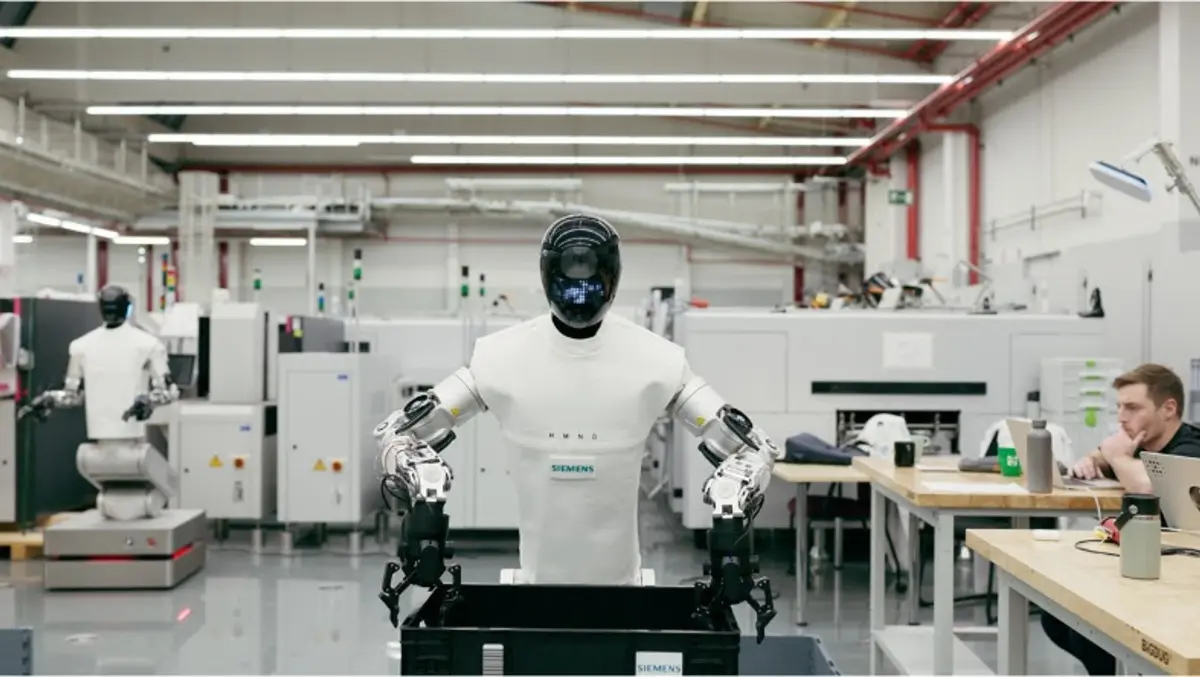
Siemens & Humanoid test robot in factory logistics
Fri, 17th Apr 2026
Siemens and Humanoid have tested a humanoid robot in logistics operations at Siemens' electronics factory in Erlangen, Germany. The robot was built using NVIDIA's physical AI stack.
In the test, Humanoid's HMND 01 Alpha carried out autonomous tote-handling tasks, including picking, transporting and placing containers for human operators. It met the target performance metrics of 60 tote moves per hour, more than 8 hours of uptime, and autonomous pick-and-place success rates above 90 per cent.
The deployment marks a practical factory use case for humanoid robotics in manufacturing, an area drawing growing attention as industrial groups seek new ways to automate repetitive work in settings designed around people rather than fixed machinery. In this case, the HMND 01 Alpha uses a wheeled base and manipulation systems designed for industrial environments.
Factory Test
The robot was integrated into logistics operations rather than isolated in a pilot cell, with links to production systems and coordination with other equipment and workers on the shop floor. Siemens positioned its Siemens Xcelerator portfolio as the software and automation layer for that integration, including digital twin tools, control systems, PLC-robot interfaces, fleet management and industrial communications.
That matters because one of the main barriers to deploying humanoid robots in factories is not just the hardware, but how well the machines exchange data with existing manufacturing systems and fit into workflows already managed through industrial automation platforms.
Humanoid, a UK-based robotics company founded in 2024, said the HMND 01 Alpha was purpose-built for factory use. It employs more than 200 engineers, researchers and other staff across offices in London, Boston and Vancouver.
NVIDIA's role is centred on the computing and training environment behind the robot. Humanoid used NVIDIA Jetson Thor for edge computing, NVIDIA Isaac Sim for simulation and NVIDIA Isaac Lab for reinforcement learning and policy training.
The companies said a simulation-first design reduced development time. According to the disclosed details, virtual modelling of actuator selection, joint strength, and mass distribution cut prototype development time from a typical 18 to 24 months to 7 months.
Industrial Push
The announcement extends a broader partnership between Siemens and NVIDIA focused on AI-driven manufacturing sites. Their work aims to combine factory automation systems with AI models, simulation tools and real-time computing so machines can adapt to changing production conditions.
For manufacturers, the appeal of humanoid systems lies in their ability to operate in spaces and workflows originally built for human labour. Unlike traditional fixed automation, such machines can, in theory, move between tasks and work areas without extensive changes to plant layout. The challenges have been reliability, safety, system integration, and proving that robots can meet production targets in live environments.
"Factories of the future demand robots that can perceive, reason, and adapt autonomously alongside human workers, tackling the labour shortages and operational complexity that traditional automation struggled to handle," said Deepu Talla, Vice President of Robotics and Edge AI at NVIDIA. "With Siemens providing the industrial integration backbone and Humanoid deploying NVIDIA's full physical AI stack - from simulation-first training to real-time edge inference - this deployment paves the way for humanoid robots meeting real production targets on a live factory floor."
Humanoid framed the project as evidence that its robot can operate beyond laboratory conditions and perform routine industrial work. The company said its system combines an omnidirectional wheeled mobility platform with its KinetIQ AI framework to operate in human-centred spaces and manage a range of tasks.
"Our mission is to create humanoid robots that perform not only in controlled lab settings, but also in real-world factory environments, handling meaningful industrial tasks. Our collaboration with Siemens and NVIDIA gives us a powerful advantage by combining NVIDIA's leading AI infrastructure, simulation tools, and frameworks with Siemens' deep industrial expertise and integration capabilities," said Artem Sokolov, Chief Executive Officer and Founder of Humanoid. "Together, we've proven that humanoid robots are ready for real-world industrial deployment."
Siemens reported revenue of €78.9 billion and net income of €10.4 billion in fiscal 2025, and employed around 318,000 people worldwide on a continuing operations basis. Siemens Digital Industries, the division focused on factory software and automation, has around 70,000 employees worldwide.