

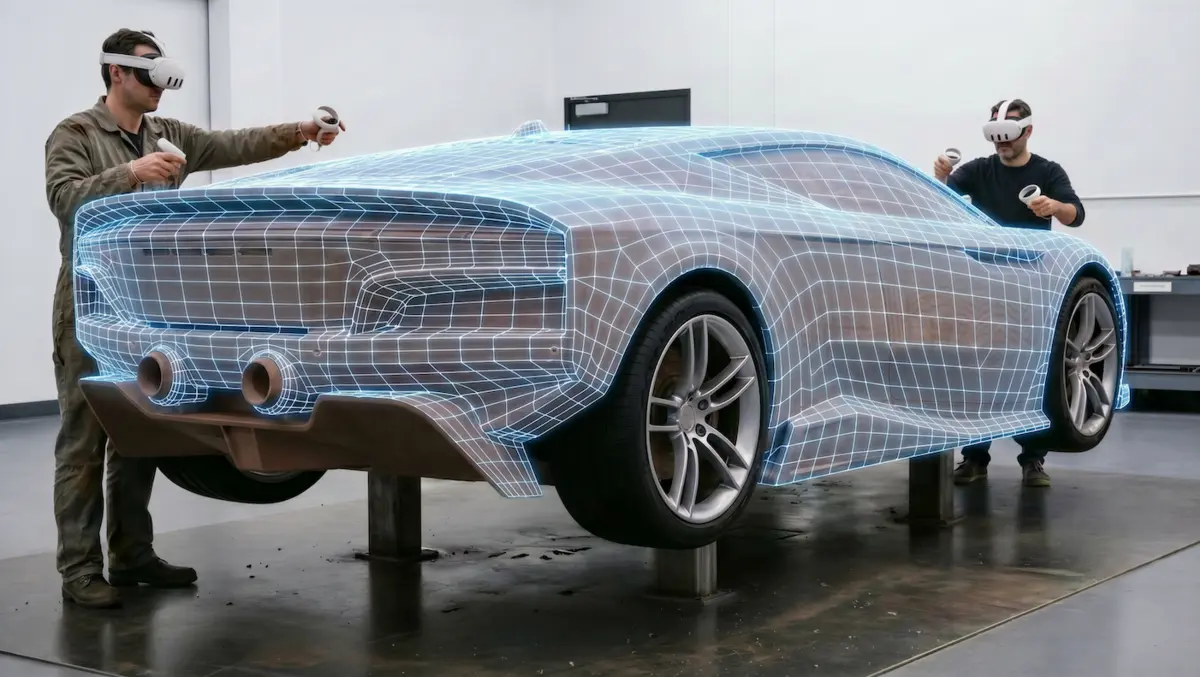
Gravity Sketch adds AR review tools for product teams
Wed, 24th Jun 2026.webp)
Gravity Sketch has released augmented reality updates for its 3D design workspace, aimed at product design teams reviewing digital models in real-world settings.
The update lets users create, edit and save spatial alignments so virtual rooms and their contents stay locked to a physical location. That includes 3D models, wireframes and sketches, which other users can then view in the same virtual room and physical space.
The London-based company says the release responds to growing demand for ways to assess rising volumes of 3D design content. It argues that the wider use of artificial intelligence in design workflows is increasing the amount of 3D material teams must review, compare and validate before moving to physical production.
Recent headset hardware changes have also helped make the update possible. Built-in depth cameras have reduced earlier problems with environmental meshing and positional tracking, making it easier to place digital content reliably in real-world settings.
Design pressure
Gravity Sketch is targeting manufacturers and product teams facing tighter budgets and more pressure on prototype spending. Higher energy costs, trade uncertainty and supply chain disruption have increased scrutiny of expensive physical models, especially where materials must be imported.
At the same time, design teams are being asked to move faster. With global teams often spread across multiple sites, the ability to review a model at true scale without travel has become more important in product development.
Gravity Sketch is used by customers including Adidas and Ford. The company says augmented reality gives teams a way to review products in context, test iterations and compare alternatives before committing to a new physical prototype.
Research cited by Gravity Sketch from Autodesk found that 98% of design and manufacturing leaders are using AI tools, including AI-generated 3D designs. The company says that trend is increasing the need for tools that help teams judge scale, proportion and ergonomics more accurately than on a flat screen.
One challenge in design review is that dimensions can be difficult to interpret from conventional CAD views or rendered images. By contrast, augmented reality lets users see a digital object at full scale and in relation to real surroundings, which can matter in areas such as vehicle interiors, workplace layouts and handheld tools.
Oluwaseyi Sosanya, Co-Founder and Chief Executive Officer of Gravity Sketch, said the shift in design work is now less about creating 3D content and more about evaluating it.
"It is very hard to read scale and proportion on a flat screen, even in CAD, so people add humans to images and still rely on individual spatial reasoning, which varies from person to person. Seeing designs in 3D with true depth perception makes it much easier to judge things like ceiling height, vehicle interiors, how a hand wraps around a tool, or how a worker's body moves when reaching into a crate. That leads to better ergonomic, layout and productivity decisions before anything physical is built. AI and hardware developments have already made access to and creation of 3D content easy. The real question now is how product teams consume it and make decisions," Sosanya said.
Prototype costs
The update is also linked to manufacturers' efforts to cut spending on physical development models. In sectors such as automotive, where full-size clay models are still widely used in design studios, each prototype can represent a substantial line item.
"A lot of the design leaders we work with are under pressure to cut costs, and they're looking hard at the number of physical prototypes they can really justify. When one clay model in an automotive studio can cost around a quarter of a million dollars, and teams are making six or seven for a flagship vehicle, that's a huge amount of time and money. With AR, a team can stand around a single physical model and explore multiple digital variations before they ever cut into the clay. Instead of building a new model every time a team wants to try a different surface or proportion, they can overlay those options in AR and decide which ones are worth committing to," Sosanya said.
The new release is also intended to support collaboration between teams in different locations by keeping shared virtual content fixed in place. Users can return to the same aligned setup later while preserving the relationship between the digital model and its surroundings.
That could help reduce some of the risk that comes with remote review, particularly where teams need confidence that everyone is assessing the same object in the same position and at the same scale. Users can also add real-world reference objects to strengthen that comparison.
"The new upgrades we've made make it possible to create, edit and save spatial alignments and lock them in a virtual room. This means all the virtual room's content stays exactly where it should be, and you can get a proper sense of occlusion and depth. You can also add real-world reference objects. Teams in Detroit can be looking at the same full-scale virtual prototype as a team in Tokyo. Instead of flying people in for every review, or building a new prototype for every option, teams can do far more iterations virtually. You can even walk away and come back to it, and the digital object will still be correctly aligned. This reduces costs, saves time and mitigates the risks of virtual reviews and costly prototypes without affecting the quality or innovation of the final product," Sosanya said.