


.webp)
XSquareSEO has published a study suggesting Google Search traffic is becoming more concentrated among a smaller group of large publishers. The analysis covered 44 major US publishing sites.
The research compared Semrush estimates for organic search traffic in a pre-AI period and a post-AI period. Total traffic across the group rose modestly from 54.6 billion visits to 57.3 billion, an increase of about 5%, even as that traffic shifted sharply between publishers.
The data points to a market in which the largest institutional news brands, sports outlets and broad authority platforms gained ground, while many digital-native and mid-tier publishers lost visibility. That suggests search demand has remained broadly steady, but referrals are being redistributed rather than reduced.
Traffic shifts
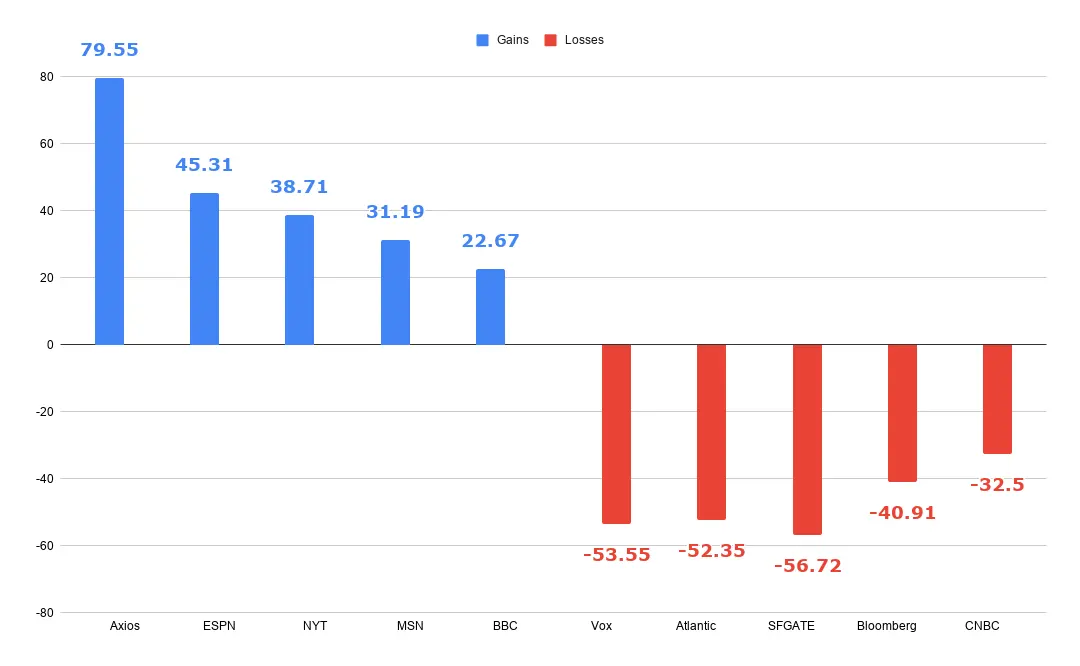
Among the strongest gainers was Axios, whose estimated organic traffic rose from 75.1 million visits to 134.9 million, a jump of 79.55%. ESPN increased from 4.7 billion visits to 6.8 billion, while The New York Times grew 38.71% from 4.1 billion to 5.7 billion.
Other notable gains came from MSN, up 31.19%, Sports Illustrated, up 30.74%, Newsweek, up 29.74%, CBS News, up 24.38%, BBC, up 22.67%, AP News, up 20.08%, and The Hill, up 14.74%.
These gains were concentrated among publishers with established brands and broad recognition. The study suggested such outlets may be benefiting from stronger trust signals and repeat audience behaviour as AI-generated answers become more common in search.
Sharp declines
At the other end of the ranking, SFGATE recorded one of the steepest declines in estimated organic traffic, falling 56.72% from 129.1 million visits to 55.9 million. Vox dropped 53.55% from 162.9 million to 75.7 million, while The Atlantic fell 52.35% from 178.8 million to 85.2 million.
Vice declined 43.59%, Bloomberg fell 40.91%, and Time dropped 40.98%. The Wall Street Journal, The Washington Post, CNBC and HuffPost also recorded declines ranging from 28.50% to 35.50%.
Some of the heaviest losses were concentrated among mid-tier digital publishers and sites that had historically relied on search discovery to build audience scale. In that reading, AI-era search changes are reinforcing an existing consolidation trend in online publishing rather than causing an overall collapse in demand.
Wider picture
Across the full sample, the report identified several common traits among publishers that performed better. These included stronger direct audience demand, broader topical authority and more recognisable brands, rather than heavier dependence on keyword-led search strategies.
The figures are based on third-party estimates rather than company-reported analytics, and the study described them as directional indicators of broader structural changes in visibility. Even so, the overall pattern was clear: gains were concentrated among a relatively small number of large publishers, while losses were spread across a wider group.
That matters for news and media groups because Google Search remains one of the main ways readers discover articles, sports coverage and explainers. If search increasingly favours established brands, the economics of audience acquisition may become harder for publishers without strong direct traffic or repeat readership.
The findings also add to a broader debate over how AI-generated search features affect web publishers. Critics argue that summaries inside search results can reduce the need for users to click through, while others contend that trusted brands may still benefit if search systems reward reputation and authority.
XSquareSEO said its analysis focused on comparative traffic distribution before and after the broader expansion of AI-generated search experiences, including Google AI Overviews. The data suggests that, despite stable overall search demand, visibility is increasingly consolidating among a smaller number of dominant publishers.