

Enterprise IoT hits USD $324bn as AI drives autonomy
Thu, 5th Feb 2026.webp)
The enterprise internet of things market rose 13% year on year to $324 billion in 2025, as companies increased spending on AI-linked deployments and activity picked up in large emerging markets such as India and China.
The figure comes from IoT Analytics' State of Enterprise IoT 2026 report. The research firm forecasts 14% growth in 2026 as companies move beyond basic device connectivity and analytics towards more autonomous operations spanning multiple sites and partners.
Device volumes also continued to climb. The total number of connected IoT devices reached 21.1 billion by the end of 2025, with enterprise connections accounting for 45%.
IoT Analytics linked the next phase of growth to a shift from monitoring assets to systems that can make decisions and take action. Fewer than 1% of IoT connections include what it calls a true edge AI component, highlighting a gap between the scale of deployments and the intelligence running close to devices.
"Enterprise IoT has become a baseline capability for many companies. The market reached $324 billion in 2025, yet fewer than 1% of IoT connections today have a true edge AI component. That gap is now driving the next phase: autonomous connected operations, where agentic and physical AI move IoT from monitoring and dashboards to systems that can optimize and act across assets, sites, and ecosystems," said Knud Lasse Lueth, Chief Executive Officer at IoT Analytics.
Shifting narrative
The report also pointed to a change in corporate language. Analysis of earnings calls showed a steady decline in mentions of "IoT", while references to "AI" and "Industrial AI" increased. IoT Analytics sees this as a sign that investment focus is shifting from connectivity programmes to AI-driven automation in industrial and operational settings.
The change matters for suppliers across the IoT supply chain. Hardware vendors, connectivity providers, and industrial software firms have long competed on device management, dashboards, and cloud analytics. A shift towards more autonomous systems increases the importance of real-time compute at the edge, more resilient communications, and software that can co-ordinate actions rather than only generate insights.
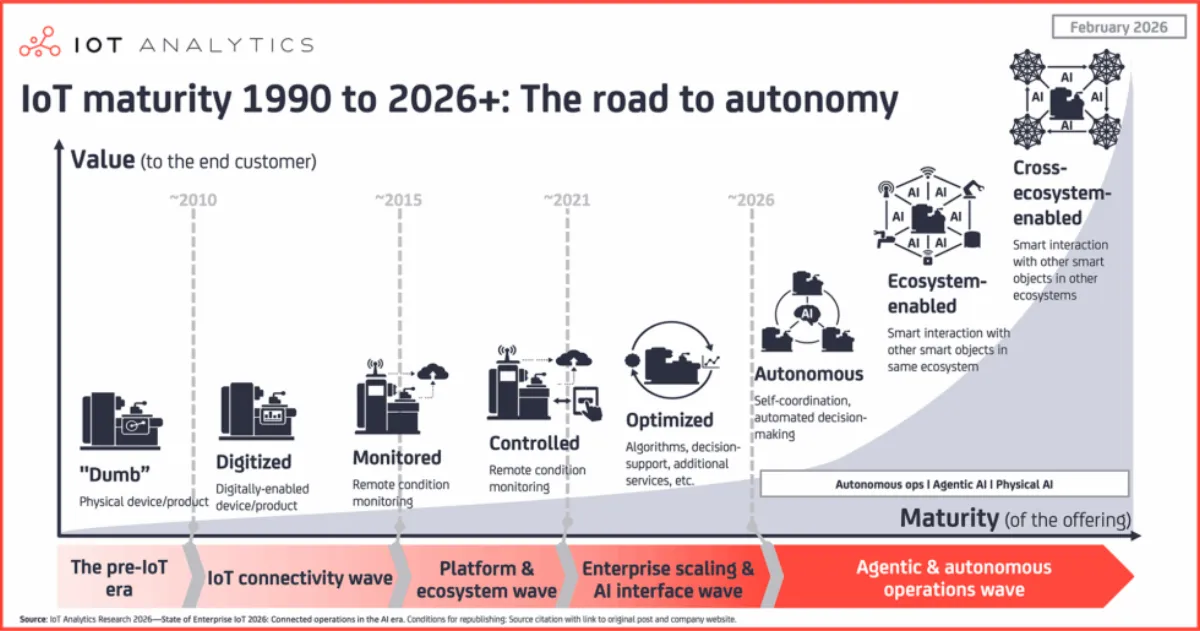
The report said the industry is entering the late stages of an IoT value and maturity curve. At this point, companies seek operational outcomes that require less manual intervention, pushing technology roadmaps towards decision-making closer to machines and new types of software workflows.
Hardware changes
One area of change is hardware design. IoT Analytics said intelligence is moving from centralised cloud platforms to edge devices, as chipmakers embed AI accelerators and neural processing units into microcontrollers. The goal is real-time decision-making on devices, rather than sending all data back to the cloud for processing.
Strategic acquisitions in semiconductors are also part of the trend. Consolidation has centred on tools and software that sit alongside chips, with vendors aiming to offer integrated development environments for building and deploying edge AI applications as embedded inference expands.
Connectivity shift
The report described a second transition in connectivity. Networks are evolving towards what it called "ubiquitous autonomy", where coverage and bandwidth support more distributed and mobile fleets of industrial equipment.
It highlighted 5G RedCap, alongside satellite links being integrated into cellular IoT modules. Together, these developments point to hybrid connectivity models, with devices switching between terrestrial cellular networks and satellite coverage depending on location and availability.
RedCap chipset shipments are projected to grow at an 82% compound annual growth rate through 2030. The forecast suggests strong supplier expectations for a tier of 5G aimed at lower-complexity devices than full 5G, while still offering better performance than older cellular standards.
Software agents
The report's third shift focused on industrial software. It said tools are moving from passive assistants to active agents that can co-ordinate workflows and trigger actions, aligning with broader interest in agentic AI, in which systems take initiative within defined constraints.
IoT Analytics said major vendors are operationalising agentic AI systems that can orchestrate more complex processes with minimal human intervention. In industrial settings, that implies closer integration between software platforms and operational technology such as machines, sensors, and control systems.
The report suggests suppliers will compete on how well they connect AI models with operational data, policies, and permissions. It also says customers will need new governance models, because systems that initiate actions can introduce safety and compliance considerations that do not arise from monitoring tools alone.
IoT Analytics, based in Germany, publishes research on IoT, AI, cloud, edge computing, and Industry 4.0. It expects market momentum to continue in 2026 as deployments expand and more companies evaluate autonomous connected operations across assets, sites, and broader ecosystems.