

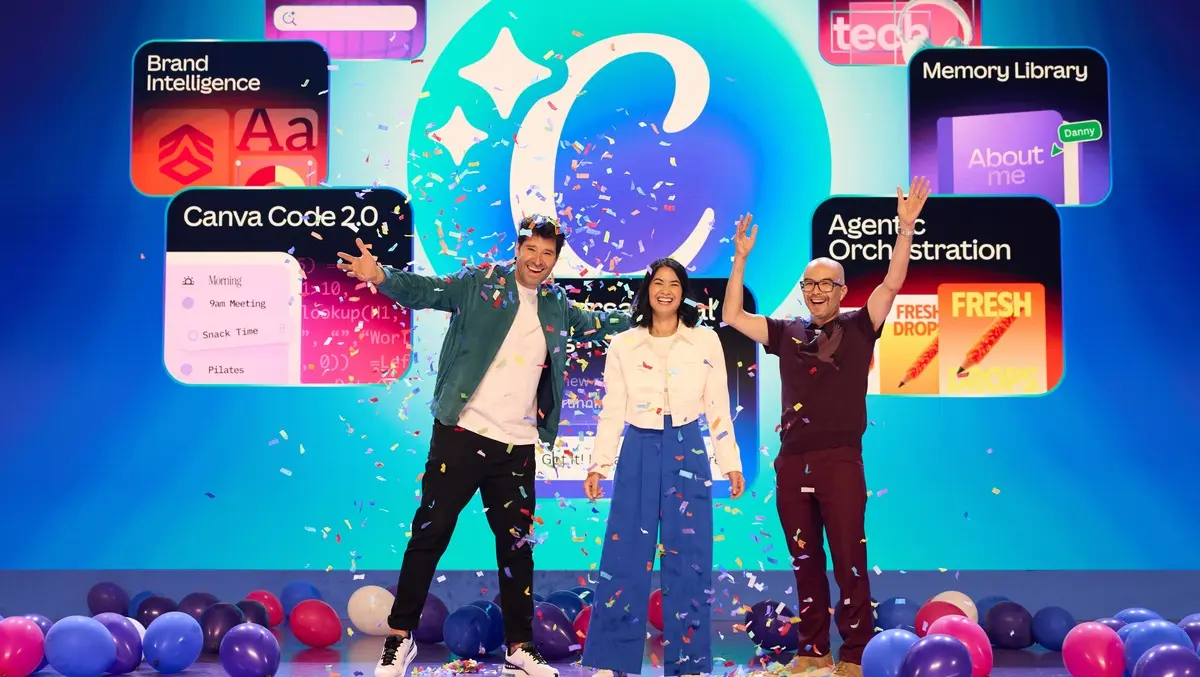
Canva launches AI 2.0 to turn prompts into editable designs
Fri, 17th Apr 2026.webp)
Canva has launched Canva AI 2.0, which it describes as its biggest product change since 2013.
The new system adds what Canva calls an AI architecture layer across its design platform. It is intended to let users create and edit work through natural-language prompts and voice input, while keeping outputs editable within Canva's existing tools.
The launch signals a broader shift in how Canva is positioning its product. Rather than limiting AI to image or text generation, it is presenting the system as a way to coordinate multiple tools and workflows through a single interface.
New features include conversational design tools, automated task scheduling, web research functions, spreadsheet generation and connectors for workplace software including Slack, Notion, Zoom, Gmail, Google Drive and Google Calendar. Users will also be able to import HTML files into Canva Code 2.0 and edit them visually within the platform.
The system can take a brief or rough sketch and turn it into editable outputs in different formats. It can also remember preferences over time, apply brand rules automatically and make targeted edits to individual elements without changing the rest of a design.
UK usage
The announcement comes as Canva reports continued growth in the UK. More than 226 million designs were created in the country over the past 12 months, including 37 million social media designs and 17 million presentations.
Globally, Canva now has more than a quarter of a billion monthly users. It also cited research from Andreessen Horowitz ranking Canva as the third most-used AI platform in the world and the fastest-growing in customer spend on AI products among leading software companies.
The new offering was built through Canva's in-house AI research unit. More than 100 researchers across its Canva Original Research and Exploration team are working on multimodal foundation models tailored for design, including image generation, image-to-video and style transfer.
According to Canva, the pace of that work has accelerated sharply. Its first generation of models took more than two years to develop, while newer models can now be trained, evaluated and deployed in as little as a month.
Canva also provided performance comparisons for several proprietary models. Its Proteus style transfer model is said to be twice as fast and 23 times cheaper than comparable frontier alternatives, while Lucid Origin for image generation is five times faster and 30 times cheaper. Its I2V image-to-video model is described as seven times faster and 17 times cheaper.
Platform strategy
The launch also includes a deeper collaboration with Anthropic. Canva's design engine and visual suite are being brought into Claude, extending the partnership between the two companies.
At the same time, users can bring artefacts from other AI platforms, including Claude and ChatGPT, into Canva for editing and collaboration. Those outputs can then be turned into websites and other publishable formats within its editor.
The move reflects a broader contest among software companies to become the place where AI-generated drafts are refined and turned into finished work. Canva is seeking to extend its reach beyond marketing graphics and presentations into routine office tasks such as meeting summaries, sales materials, newsletters, campaign plans and briefings.
That strategy was central to the company's comments around the launch. "Just over a decade ago, Canva transformed design by making it radically simpler, more accessible, and more collaborative," said Melanie Perkins, co-founder and chief executive officer of Canva.
"Canva AI 2.0 marks the next major leap forward, reimagining not just how people design, but how they work. We're entering a new era where software is intelligent, tasks are automated, and creativity is more powerful than ever. Our vision is to become the most accessible, agentic AI platform in the world, helping every person and organisation turn ideas into reality," Perkins said.
Canva AI will initially launch as a research preview for the first one million people who find it on the company's homepage.