

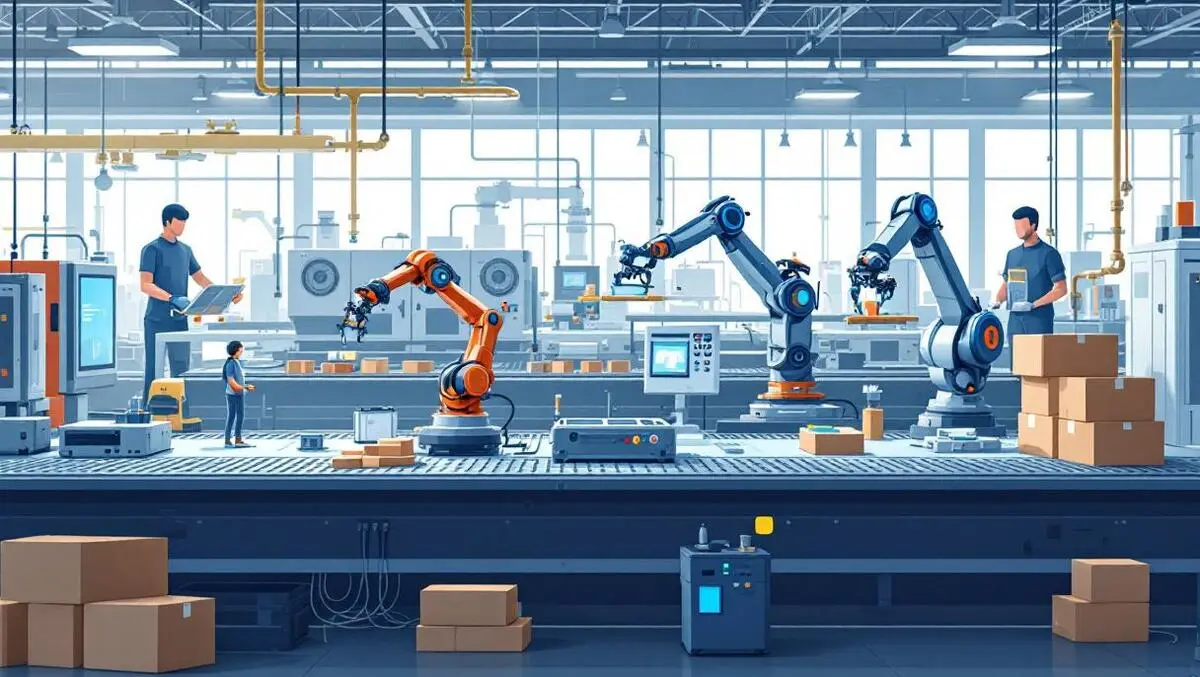
AI & industrial data drive manufacturing towards autonomy
Thu, 9th Oct 2025
Manufacturing leaders are increasingly adopting artificial intelligence (AI) and connected data strategies to enable scalable, autonomous operations across their enterprises.
According to Troy Mahr, Director at Kalypso, a company acquired by Rockwell Automation in 2020, real-time visibility across global operations remains a priority for industry leaders seeking agility and scalability. Mahr emphasised the necessity of moving away from traditional manual data collection methods, stating that achieving true operational flexibility is not possible without deploying connected assets and contextualised data.
Mahr explained, "By eliminating data silos and unlocking industrial data and artificial intelligence (AI) capabilities, companies can enable autonomous decision-making that optimises costs, efficiency, and production resilience. This moves their organisation closer to achieving autonomous operations."
Autonomous operations
He described autonomous operations as the realisation of "self-governing" systems at every manufacturing stage. Such systems harness data-driven decision models to adjust their behaviour in response to changing operating environments, without manual intervention.
"Achieving autonomy across an enterprise requires capabilities that span the full intelligence spectrum, from observation and inference to decision-making and action," Mahr said. "These capabilities are relevant across all operational areas, including product design, manufacturing, supply chain, distribution, direct-to-customer channels, and demand forecasting."
He noted significant advancements in manufacturing operations through Model Predictive Control (MPC), which continuously analyses both real-time and forecasted data to optimise process control within predefined constraints. According to Mahr, this marks only one aspect: "While MPC is a strong example within manufacturing, broader autonomy demands extending similar intelligent systems across the enterprise."
Mahr referred to the industrial AI maturity pyramid, describing it as a model that illustrates progression from basic data integration and visualisation to advanced stages such as predictive analytics, prescriptive decision-making, and ultimately fully autonomous operations. He highlighted that each level on this pyramid necessitates not just technology investment but also significant cultural and organisational changes.
Asset monitoring
Among the foundational steps is asset monitoring, cited by Mahr as an important transition from observation to explanation within the maturity pyramid. Effective asset monitoring, he noted, is vital for operational efficiency and minimising downtime.
He said, "By better understanding sensor data trends, alarming, and maintenance work order context, businesses can quickly identify and address root causes of downtime through engineering analysis."
Mahr suggested that by comparing the performance and reliability of similar equipment across multiple facilities, manufacturers can optimise asset use, prevent unexpected failures, and extend the lifespan of critical assets.
Quality control
Moving up to the inference layer of the maturity pyramid, quality control is identified as crucial for customer satisfaction and regulatory compliance. Mahr explained, "AI can detect and suggest corrections for deviations that impact product quality, automate the inspection process, and predict when quality issues are likely to occur. By monitoring the quality of incoming materials, businesses can reduce the risk of defects."
He highlighted the application at Rockwell Automation's Twinsburg manufacturing plant: "In this case, Industrial AI provides alerts for potential faults that allow teams to take proactive action. While this approach stops short of making the changes itself, it significantly enhances the decision-making process."
Mahr asserted that early detection and prediction of quality issues is essential for reducing waste and ensuring stringent standards are met.
Adaptive manufacturing
Adaptive manufacturing is another area where AI is impacting operations. Mahr explained, "AI analyses production and market conditions to autonomously adjust schedules, equipment, and workflows in real-time." He stressed that this primarily supports resources around the production line, particularly in situations requiring swift adjustments to production based on downstream feedback.
"It's important to highlight that you're managing supporting resources for production, and this is really where your autonomous manufacturing begins."
Predictive maintenance
Predictive maintenance is described by Mahr as a proactive approach, leveraging AI to analyse historical and current equipment data to anticipate malfunctions. This enables more efficient maintenance scheduling and reduces unplanned downtime. Mahr said, "This approach is similar to providing alerts to the team that a fault could occur, allowing them to take preemptive action."
He also addressed the organisational challenges inherent in adopting advanced predictive maintenance solutions, pointing to hurdles such as skills development and talent retention. Mahr believes that advances in edge computing and analytics are providing new avenues for embedding machine learning directly into intelligent devices.
Mahr described predictive maintenance as an integrated solution: "It's hardware, software, and services brought together seamlessly under one roof, representing the next evolution in condition monitoring technology."
Process optimisation
Expanding on practical applications, Mahr identified process optimisation through MPC as another instance where industrial data and AI are unlocking new capabilities. He stated, "Detailed insights into production processes enable the identification and resolution of inefficiencies. MPC allows for the modelling of specific operations within a plant, managing set points within a PLC to control equipment, and using data science to course-correct in real-time."
Mahr observed that MPC enables manufacturers to both read data from sensors on the production line and instruct the process logic controller (PLC) to adjust production rates as necessary, helping maintain optimal performance as conditions evolve.
Looking ahead
"The integration of industrial data and AI is transforming operations across various domains, from asset monitoring to predictive maintenance. By unlocking Industrial AI capabilities, businesses can move closer to achieving autonomous operations, making better, faster, and more informed decisions. As technology continues to evolve, the vision for fully autonomous operations becomes increasingly attainable, promising a future of enhanced efficiency, reliability, and adaptability."
Mahr concluded, "The journey towards autonomous operations involves incremental steps, each bringing businesses closer to a state where systems can independently manage and optimise processes, ensuring sustained growth and resilience in a competitive market."